Buggy, truggy, short course, stadium truck, crawler, touring, drift and drag, explained plainly with benchmark models and which class fits your local track.
People wander into this hobby and immediately hit a wall of jargon. Buggy, truggy, short course, stadium truck, crawler. It sounds like a lot, and half the advice online is somebody defending whatever they happen to own. So here's the plain version from someone who's owned most of these and broken all of them.
A "class" is two things at once: a body-and-chassis style, and a set of rules that lets a bunch of them race together. Pick the wrong one for where you actually drive and you'll be miserable no matter how good the car is.
The buggy is the oldest competitive shape in RC and still the one the racing world orbits around. Open-wheel, low, light, built to rail around a dirt or carpet track.
This is the class where the fastest drivers live. If you want to actually get good, a 1/10 2WD buggy is the schoolteacher that never lets anything slide, because it punishes sloppy throttle. The Team Associated B6 line and the TLR 22 are the two names you'll see on every podium, and either one has parts on the shelf at any real hobby shop. There's 4WD too (the B74, the TLR 22X-4), which is faster and more forgiving but hides your mistakes. That's exactly why I tell new racers to start with 2WD. It's cheap to run and it makes you honest.
Take a 2WD buggy, bolt on taller shocks, bigger tires and fenders, and you've basically got a stadium truck. Traxxas built half its empire on the Rustler, which is the benchmark bash version, and the Team Associated T6 is the racer's version.
Compared to a buggy it's more planted and more tolerant of hitting things, which makes it a good first car for a big yard or a rough local track. It gives up a hair through tight corners because of the extra height, but nobody's ever complained about that.
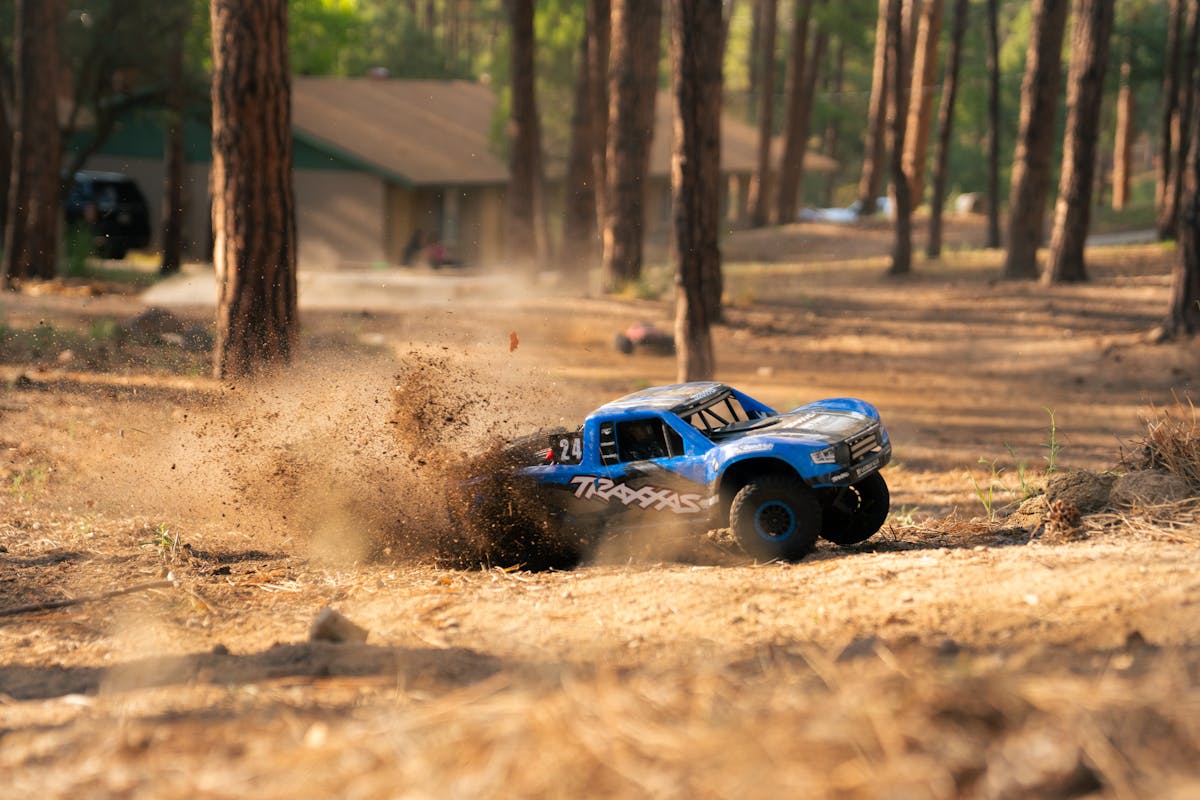
This is the class that pulled a whole generation into RC, mostly because the Traxxas Slash exists. Short course trucks are scale replicas of desert race trucks, fully fendered and tough, and those big pinched tires and enclosed bodies shrug off crashes that would tear a buggy apart.
The Slash 2WD is the one I hand to anyone new. Cheap, close to indestructible, endless parts and hop-ups. On the race side you'll see ProLine bodies and the TLR 22SCT, and Team Associated's SC line races hard too. They're not the quickest thing out there because of the weight and the wind resistance, but for fun-to-durability ratio nothing beats one. It's the pickup truck of the hobby.
A truggy is a truck-buggy mashup: 1/8 scale, 4WD, monster power, running the same guts as a nitro or electric race buggy but wearing a wide truck body and huge tires. Losi 8IGHT-T, the Tekno ET48 crowd. They're fast and they jump enormous.
The difference comes down to scale and intent. A 1/10 buggy is a precision tool for a groomed track. A 1/8 truggy is a sledgehammer for a big rough outdoor track with tall jumps. If your local spot has table-tops you could land a real truck on, a truggy is a blast. On a tight indoor clay oval it'll feel like parking a bus.
Big body, huge tires, tons of ground clearance, built to smash and jump rather than lap a track. The Traxxas Stampede is the affordable entry and the Arrma Kraton is the go-big 1/8 monster that'll do backflips off a curb.
There's no real organized race scene here, which is fine because that was never the point. Monster trucks are for the backyard, the skatepark, the empty lot. If you've got kids, or you just want to hand a car to a buddy and watch them grin, this is the one.
The opposite end of the hobby. Crawlers go slow on purpose. It's about picking a line over rocks, articulating over obstacles, and not tipping over, all at walking speed.
The Axial SCX10 and its smaller SCX24 cousin are the platforms everybody builds on, and the scene is enormous and endlessly customizable. There are two flavors: scale crawling, which is realistic trail rigs, and comp crawling, which is purpose-built two-speed machines that look like insects. This is the one corner of RC where you can happily spend a Saturday moving twenty feet, and you don't need a track. Your driveway rock garden is the course.
Smooth pavement, sedan-style bodies, four-wheel drive, and speed that will genuinely scare you. Touring cars like the Xray T4 and the Team Associated TC7 run on asphalt or carpet, on ovals and road courses. It's a real race class with a serious crowd, and the driving is about lines and consistency rather than survival.
You do need smooth ground. A touring car on a rough surface is a bad afternoon. But if you've got a parking lot or an on-road track nearby, it's some of the most rewarding driving in RC.
On-road's stylish sibling. Drift cars run hard low-grip tires, basically PVC or ABS, so they slide predictably. The whole point is holding controlled slides, chaining corners, and looking good doing it. Lap times don't come into it.
The Yokomo and MST platforms are popular and there's a whole aesthetic scene around scale bodies and underglow. It's judged more like a style event than a race. If you liked those car movies, you already know whether this is for you.
Straight line, launch hard, don't wheelie into the ceiling. RC drag has grown into a legit niche running prepped short strips, where the game is a clean 60-foot launch and consistent runs. It's a tuner's class, so you'll fuss over wheelie bars, weight bias and gearing more than steering, because there's barely any steering involved. Traxxas even sells a Drag Slash aimed right at it. Small scene, obsessive people.
This took me too long to understand. You don't buy a car and then find somewhere to run it. Figure out where you'll actually drive and let that pick the class. A 1/8 truggy needs a big outdoor track with real jumps, a touring car needs smooth pavement, a crawler needs rocks and nothing else. Buy the car your nearest spot supports and you'll run it constantly.
So before you spend anything, go see what's near you. The tracks and hobby shops directory will tell you whether your local scene runs buggies, short course, or nothing at all, and the events calendar is worth checking so you can watch a class in person before committing. Ask the people there what they run and why. They'll talk your ear off, and it's the fastest education you'll get.
When you know what you want, the used listings are where I'd start shopping. A gently used race roller from someone who upgraded is almost always a better first buy than a new box, because it comes sorted and often with spares. If the numbers on those listings don't mean anything to you yet, RC scales explained untangles 1/10 versus 1/8 versus everything else.