How RC radio really works: transmitter vs receiver, channels, binding, why 2.4GHz protocols are brand-locked, and which radio to buy by budget.
The radio is the part of your RC car that new people think about least and then get burned by first. You buy a used truck, it comes with a transmitter, everything runs. Then you buy a second car with a different receiver and none of your gear talks to each other. That confusion is almost always because nobody explained how the two halves of a radio system work.
The transmitter is the thing in your hands. Wheel on the side, trigger for throttle, a couple of buttons and dials. The receiver is a little board buried inside the car, usually near the steering servo, with an antenna wire sticking out. When you turn the wheel, the transmitter sends that command over the air, the receiver catches it, and it tells the servo and the speed controller what to do.
One talks, one listens. On surface RC they're almost always sold as a pair, and the pairing matters more than people expect.
A channel is one thing the radio can control independently. A basic ground car needs two, steering and throttle, which is why you'll see radios described as 2-channel. For a stock buggy or short course truck, 2ch is genuinely all you need and I'd tell you not to overspend.
The third channel is where it gets fun. On a rock crawler that's usually a locking differential or a two-speed transmission. On a scale rig it might run a winch or turn your lights on. A fourth channel opens up more of the same: a second winch, a trailer hitch servo, whatever scale nonsense you've talked yourself into. If you're crawling, get at least 3 channels. If you're bashing or racing, don't pay for them.
Binding is the handshake. It's how a specific transmitter and a specific receiver agree to only listen to each other, so your car doesn't take off when the guy next to you at the track pulls his trigger.
You do it once. Usually you plug a little bind plug into the receiver, power it up, hold a bind button on the transmitter, and after a second or two the receiver's LED goes solid. It remembers that pairing until you re-bind it to something else.
If your car suddenly won't respond and everything else looks fine, a lost bind is one of the first things I check. It's rare, but a dead battery mid-bind or a firmware hiccup can drop it, and re-binding takes thirty seconds. That's also step one in my won't-run troubleshooting walkthrough.
This is the part that trips everyone up. Modern surface radios run on 2.4GHz, but 2.4GHz is just the band, not a language. Each brand speaks its own protocol on that band and they don't understand each other.
Spektrum uses DSMR. Futaba has its own surface protocol. FlySky runs AFHDS, in 2A or 3 depending on the radio. Radiolink does its own thing too. A Spektrum transmitter cannot bind to a FlySky receiver, and it doesn't matter that both are 2.4GHz. It's a Ford key in a Toyota.
So when you buy a used car and it comes with a receiver, that receiver only works with a transmitter from the same protocol family. Buy a bare receiver to match the transmitter you already own, not the other way around.
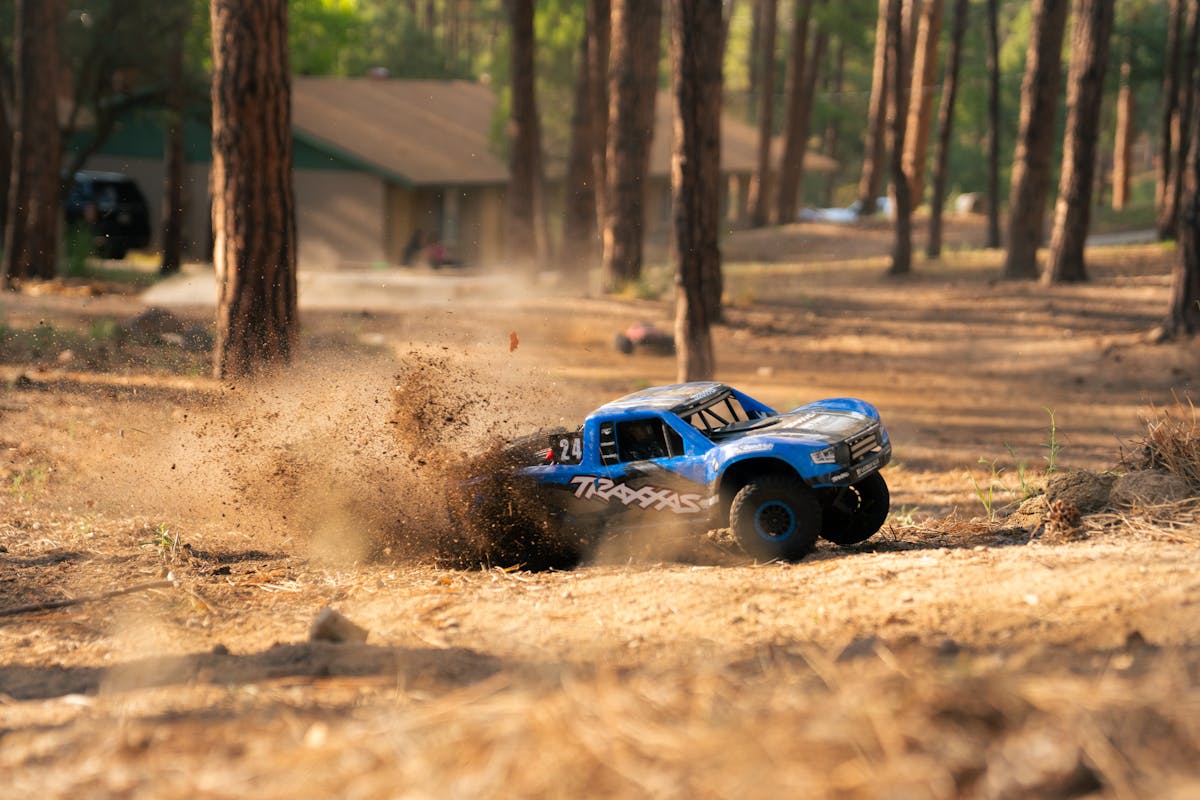
When you buy a ready-to-run car it ships with a transmitter and receiver already bound. These are basic: two channels, a couple of trims, maybe a dual-rate dial. Traxxas RTRs come with the TQ, which is a perfectly fine little radio, and Arrma and Losi ship their own entry pistol grips. They all work.
My honest take is that the included radio is fine to learn on and I wouldn't rush to replace it. What it doesn't give you is fine control over the car's feel: throttle curves, endpoint adjustment, exponential on the steering to calm a twitchy car down. You'll drive the stock radio for a season, hit its limits, and start wanting more. That's the normal path.
Buy the upgrade when you've got more than one car, or when you're tuning setups seriously and want the transmitter to remember settings per vehicle. Model memory alone is worth it, since the radio stores a profile for each car and you're not re-trimming every time you switch.
Don't get talked into a four-figure radio for a backyard basher. A GT5 or a used DX-series does everything a normal driver needs, and the money is better spent on tires and a good charger.
Telemetry is the receiver sending data back to your transmitter mid-run: battery voltage, motor temperature, RPM, sometimes speed. It sounds like a gimmick until you've melted a motor. A live temp readout will tell you your gearing is wrong before you cook something expensive.
The catch is that it needs a telemetry-capable receiver plus sensors, and it's brand-locked like everything else. It's nice to have, not a reason to pick a system. If you're chasing performance it earns its keep, and if you're having fun in the cul-de-sac, skip it.
Match your brand, bind once, don't pay for channels you'll never use. If you're still picking out your first car, my first RC car guide covers what to look for, and before you buy into any one protocol it's worth seeing which brands people around here actually run.