Getting into RC cars? Here's the toy-grade vs hobby-grade truth, a realistic starter budget, the main ways to enjoy the hobby, and what actually breaks.
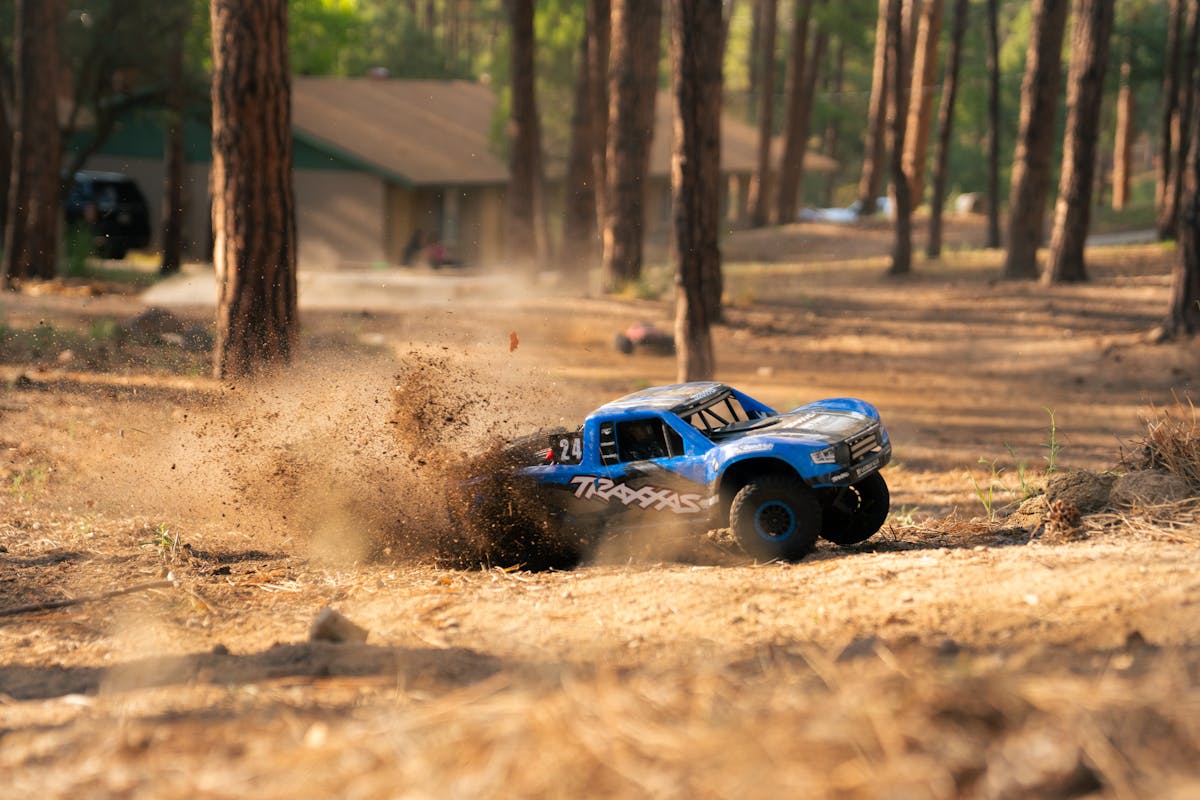
So you want to get into RC cars. It's one of the few hobbies where you can buy something, drive it into a curb at 40 mph, and then fix it yourself in the garage that night.
The first purchase is where most people trip, usually because they buy the wrong kind of car and don't even know there's a wrong kind. Let me save you the mistake I made, and a few hundred bucks while I'm at it.
If you get one thing right, get this one.
A toy-grade RC is the thing at Target or Walmart in a sealed blister pack, non-brand or a brand you only ever see on toy shelves. It runs $30 to $80. The electronics are soldered together, the battery is glued in, and when a gear strips (it will) there are no replacement parts. You throw the whole car away. It's disposable by design.
Hobby-grade is a completely different animal. Traxxas, Arrma, Team Associated, Losi, Axial, Tekno, Xray, Schumacher. These cars are built to come apart. Every gear, driveshaft, and arm has a part number you can order, and the motor, speed controller, servo, and receiver are separate components you can swap or upgrade. You're not buying a toy, you're buying a platform.
The easy tell is parts. If you can't find a parts list for it, it's a toy. A real hobby-grade car comes with an exploded diagram where every screw has a number. Traxxas is famous for this, and you can order any piece of the car off it.
People see a $600 Arrma and assume that's the entry fee. It isn't. But the sticker price on the car is never the real number either.
A sane all-in beginner budget is roughly $150 to $450, and here's where it goes:
The car is the cheap part over time. Batteries and a charger are where the real number comes from, and those carry over to whatever you buy next. Buy a good charger once.
If your budget is tight, watch the deals page. RTR kits go on sale constantly, and last year's model is usually 80% of this year's car for 60% of the price. A lightly used hobby-grade car is a genuinely smart first buy too, since it comes apart and you can fix whatever's tired on it.
"RC car" is like saying "bicycle." There are wildly different disciplines and they don't overlap much. A good crawler makes a terrible basher and the reverse is just as true, so figure out which one you are before you buy.
Jumping, drifting in the parking lot, sending it off a dirt mound. This is where most people start and honestly where most people stay. You want a tough monster truck or stadium truck: an Arrma Granite or Big Rock, a Traxxas Stampede or Rustler, a Losi. Durable, forgiving, and plenty fast enough. It's the least fussy way in and I'd point most beginners here.
Actual competition on a track, usually 2WD or 4WD buggies and short-course trucks. Team Associated, TLR, Xray and Schumacher live here. More precise, more tuning, more money, and a lot more fun than it looks from the outside because the local club scene is genuinely welcoming. If this is you, find a track before you buy the car. The regulars will tell you exactly what class runs on Tuesday nights.
Slow-speed rock crawling and scale trail rigs. Axial is the king here, with the SCX10 and SCX24 as the default answers and the Traxxas TRX-4 in the mix. No speed, all finesse and articulation and picking a line up a rock pile. It's quiet and it's easy on both batteries and parts. A lot of people who burn out on bashing end up here.
Touring cars and drift cars on pavement. Faster and smoother than it sounds, needs decent asphalt, and the drift scene has blown up in the last few years. Smaller crowd, but the people in it are obsessed.
If you're not sure which fits, I wrote a whole piece on how to choose your first RC car that walks through it by use case.
You're going to break stuff. Nose-first into a tree, a bad landing, a dog running through the yard at the wrong moment. New people panic about this and they shouldn't.
The reason hobby-grade matters is that when you break a front arm, you order a $6 arm and you're running again in ten minutes. The usual casualties are suspension arms, driveshafts (CVDs and dogbones), turnbuckles, gear diffs, and the spur gear. That last one is designed to strip so it saves the more expensive parts behind it, so a stripped spur after a hard hit is the system working correctly.
Keep a small spares box from day one: an extra spur gear, a set of arms, a couple of driveshafts, and some hardware. Every RC person has this box, and it turns a broken afternoon into a fifteen-minute pit stop.
Electronics fail differently. The usual killers are water where it shouldn't be, a motor cooked from too much gearing, and a servo stripped on a curb strike. Hobbywing and Castle make the speed controllers and motors most people upgrade to, and Spektrum, Futaba, FlySky and Radiolink cover radios from budget to serious. All of it is swappable.
The tools are simple. Metric hex drivers (2.0, 2.5 and 3.0mm cover most of a car), a set of nut drivers, needle-nose pliers, and thread-lock for the metal-to-metal screws. About $40 of tools and you can wrench on anything.
The battery question trips up more beginners than anything except the toy-grade mistake, so if you're already circling it, read up on NiMH vs LiPo before you spend a dollar on packs.
Then find your people. Punch your area into the tracks and shops directory and see what's actually near you. A local track or hobby shop is worth ten forum threads, and the guys there will hand you parts and advice for free. When you're ready to buy, the used listings are where I'd start looking for that first hobby-grade car. Buy someone's clean upgrade cast-off, break it, fix it, and you're in.