Picking a beginner RC car starts with where you'll drive it. Real picks from Traxxas, Arrma, Losi and Axial, honest prices, and the hidden costs to plan for.
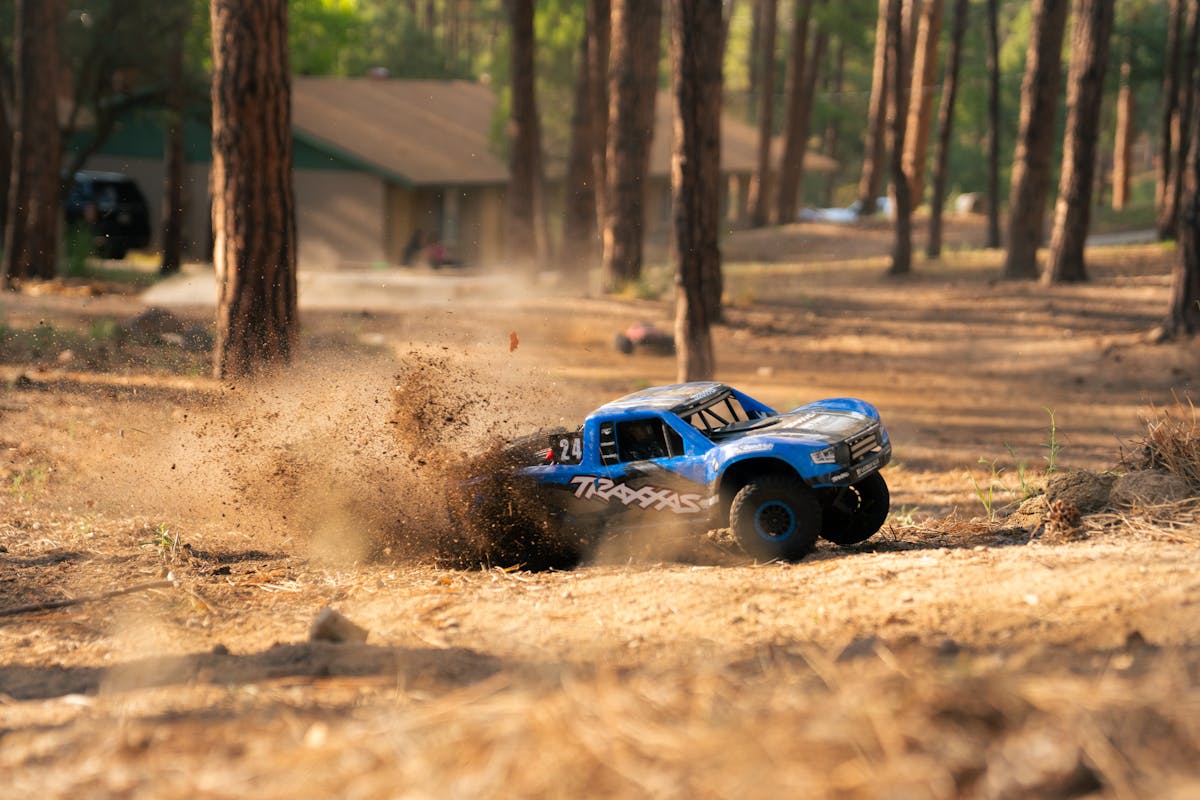
Every week someone asks me the same thing. "I want to get into RC cars, what should I buy?" And every week I ask them one question back before I answer: where are you going to run it?
That answer decides everything else, and most beginners do it backwards. They pick a car they saw on YouTube and then go looking for somewhere to drive it. Start with the ground instead.
Be honest about this one. Not where you dream of driving, where the car will actually spend its weekends.
If that's your backyard, a grass park, or a gravel lot, you want something durable and forgiving that can take a bad landing. A short-course truck or a basher buggy. If it's a paved cul-de-sac or an empty parking lot, on-road or a stadium truck will feel much faster and handle better than a lifted basher ever will.
If there's a real hobby track near you, that changes the whole equation, because now you've got people to race and a surface that rewards good setup. Check the tracks and shops directory before you assume there isn't one. You might be surprised what's within an hour.
And if you're eyeing rocks, roots, and creek beds, that's crawlers, which is a totally different animal. Slow, torquey, geared for climbing instead of speed.
Pick the surface, then pick the car. A backyard basher gets bored on a smooth track and a track car gets beached in the grass.
Scale is just how big the thing is relative to a real car. 1/10 is the default for most of the hobby: big enough to survive hits, small enough to run in a decent-sized yard, and the parts are everywhere.
If you're tight on space or want to run indoors, 1/18 and 1/24 are genuinely good now, and I'll name a couple in a second. Go up to 1/8 or 1/5 and you get serious speed and presence along with a car that needs real room and a wallet to match. I've seen people buy a 1/8 nitro monster as a first car and run it exactly twice before it lived in a closet.
For most first-timers 1/10 is the sweet spot and 1/18 is the smart small option. There's a whole guide on RC scales if you want the longer version.
Unpopular opinion: for a first car, brushed is fine. Maybe better.
Brushless motors are more efficient, run cooler, and go a lot faster. No argument, and eventually you'll want one. But a brushed setup is cheaper, simpler, and slow enough that you can actually learn to drive without wrapping the car around a fence post in the first ten seconds. A slower car teaches you throttle control, and throttle control is most of driving well.
The other thing nobody mentions is that brushless cars tempt you into bigger batteries and harder driving, and that's how beginners cook electronics. You'll graduate soon enough, and by then you'll know what you want out of it. The classes guide covers what separates the categories if you want the full rundown.
Real picks, roughly what they cost new as I write this.
Traxxas Slash. The default answer for a reason. A 1/10 short-course truck, tough as a boot, and the parts and upgrades are in every hobby shop in America. Around $250-300 ready to run. If someone with zero research just wants one good car, I hand them a Slash and I don't feel bad about it. Traxxas's support and manuals are also better than most, which matters when you break something at 9pm.
Arrma Vorteks or Typhon. If you want brushless speed out of the box and a build that shrugs off abuse. The Vorteks is a 4x4 stadium truck, the Typhon a buggy, both in the $300-400 range depending on version. These are fast, so respect that on day one.
Losi Mini-T 2.0 or Mini-B. Small scale, brushed or brushless depending on the trim, and shockingly capable for the size. Roughly $130-200. This is my pick if your track is a driveway and a garage floor. Small enough to run indoors in winter, quick enough to keep you honest.
Axial SCX24. If rocks are your thing, start here. A tiny 1/24 crawler, roughly $100-130, that will climb stuff in your living room and your backyard alike. Cheap way to find out if crawling grabs you before you spend real money on a 1/10 rig.
This is what ambushes people. The car is not the whole bill.
Batteries are the big one. A ready-to-run car often includes one battery, sometimes a cheap one, sometimes none. You'll want two or three so you're not sitting around waiting on a charger between runs. Figure $25-50 each for a decent LiPo, more for the good stuff.
Then a real charger. The wall-wart in the box is slow and dumb. A proper balance charger runs $40-80 and it's the single best early upgrade you can make. Get one that balances LiPo cells properly, because battery safety isn't optional with these packs.
Then spares. You will break parts, not might. A couple of spare axles or driveshafts, a set of tires, some body clips (you'll lose those in the grass constantly), maybe a spare servo horn. Budget another $40-60 up front and thank yourself later when you're not benched for a week waiting on a $6 part. Add AAs or a rechargeable pack for the transmitter too, since a Spektrum or Traxxas radio eats them.
Rough math: a $250 car is really a $400 car once it's runnable and you're not stranded on your second battery. Plan for it and it won't sting.
Used is how you get a $400 setup for $250, and RC gear holds up better than you'd think if it was cared for. A lot of guys buy a nice car, run it a handful of times, life happens, and it sits. That's your deal.
Watching what actually sells gives you a feel for fair prices, and the deals page is worth a scroll for price drops. Used often comes with the extras thrown in too: spare batteries, a charger, spare parts, sometimes a pit bag full of tools. That bundle is where the real value is.
Two things to check before you hand over cash. Run it, and look at the wear. A car that powers up, steers both ways, and drives straight is telling you the electronics are alive. Cracked chassis, stripped gears, and hacked-up wiring are telling you the opposite. I put together a used-buying checklist that walks through what to inspect and what's a walk-away, so read that before you meet anyone.
New or used, do the surface step first. Everything downstream gets easier once you've named the ground you're driving on. Start by seeing what's listed near you and let the real prices tell you what your budget actually buys.